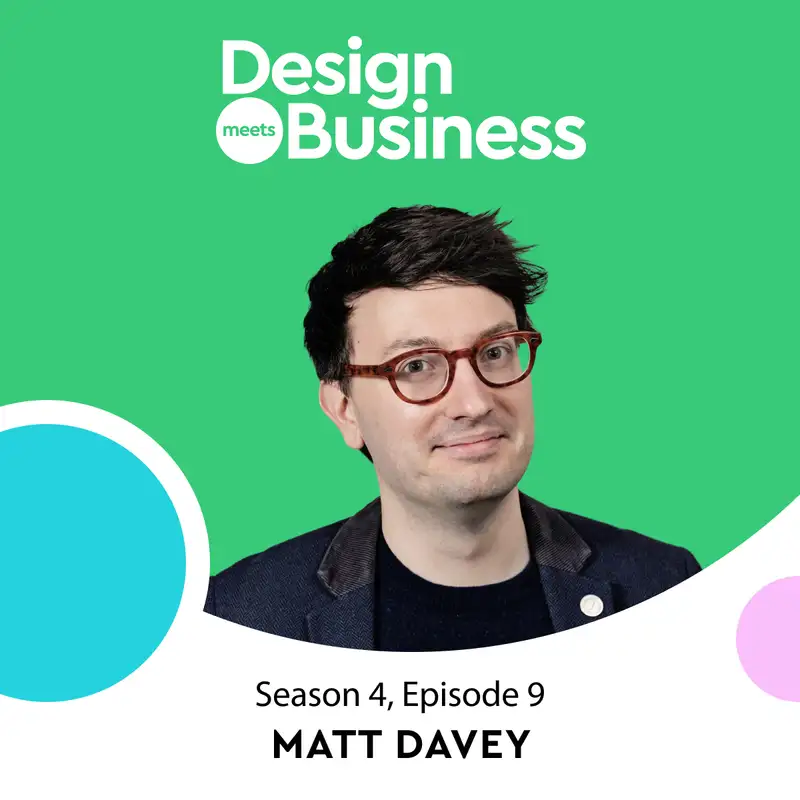
Staying Useful as a Designer, Making Good Trouble, and How AI is Reshaping Design, with Matt Davey (CXO at 1Password)
Christian: Matt, it's great to have you on Design Meets Business. Welcome. You have been at 1Password for more than a decade, starting out as a designer and now leading as Chief Experience Officer with a hand in not just design, but marketing and partnerships. And perhaps beyond that, maybe we'll get to talk about that.
It's rare that I get to talk to someone who's been with one company for so long and a successful company on top of that. And there's a lot that I love to unpack from that journey. But to kick things off. How did it all begin for you? How did you end up where you are today?
Matt Davey: Thank you for having me first of all. Yeah, it's an interesting one. I actually applied to a completely different job and someone passed along my portfolio and then it ended up in the hands of 1Password. But I was part-time for the first maybe four or five years I was contracting and working for various fintechs and working for, all sorts of people.
It was the days where you know, we were just starting to understand. Mobile apps and like what to do or mobile. And I used all of the different companies that I was working for to gain knowledge and gain understanding about what works on mobile. And this was in the days where we were pretty good as 1Password on iOS.
And we were starting to, you know, we, I think we had our own browser, like built into the app and you could slide it across. We were doing all sorts of weird stuff to try and get around, system constraints and, and that type of thing. And I was then like using that knowledge around building mobile products and working with, much bigger companies like HSBC and First Direct and some other like big banks and basically using that understanding of these people are actually building really good mobile apps and like I'm helping design them and all of that type of thing. And then I'm using that knowledge to set direction and understanding a much higher kind of company level in, in these other places. And so I, I was really happy doing that for a good four or five years.
And then you start to realize, oh, actually, like it's really hard to ship stuff in massive companies. And so I followed the pace of 1Password and I joined full-time and we started to make massive inroads on password management and that type of thing.
So it was a really good move to go full time. And then I was like, God, I've been here like, six years and, it started to get a bit like, oh my goodness , am I doing this forever now? But I think the constant change and the constant scale really makes it like really apparent when you have a chapter change.
1Password has been through many and each chapter change, I think it has lined up perfectly that is, there is something really interesting and something new on the horizon of each one. So think like I'm this weird, unique case of every time I think ah, that's a good end of a chapter and I'm starting to, get itchy feet or anything like that.
The internal thing that is very interesting is just so much more interesting than the external interesting thing, you know.
Christian: Yeah it's this interesting idea changing of changing the chapter in the company that maybe oftentimes doesn't happen. So you're sitting in a company, you've been there for 2, 3, 4 years, whatever it may have been, and then you... you're irking for something new or you're thinking, well, there's, it is not that challenging anymore.
Maybe I'm not learning so much anymore, but I guess what you're saying is that maybe that hasn't been a problem at 1Password. 'cause every two, three years or whatever, when that irk would happen, the company would grow and would move into the next chapter. So it Is kind of like changing jobs three, four times over the past 10 years or so, isn't it?
It's more or
Matt Davey: A hundred percent. I often think and one of the things I've given talks on this it's one of the kind of principles that I live my life by is I think like self-awareness of when those chapters happen is so important, because you could be in a job for like two to three years and you can kind of be trundling along and that chapter's changed.
No one tells you. And there's no, you know, notice that goes round and, and says, Hey, that job that you're doing, you should be doing it completely differently. that, That never happens. No one ever tells you. And like, it's absolutely unfair, what isn't. And so like your job changes and the amount of impact that you can have changed, the amount that you are useful changes. And so, say it changes one and a half years into a role and you end up being there for three years . No wonder that kind of year and a half after is downhill because having that awareness and being like, oh my God, has my role changed?
Like how do I deal with that, that's really important. One of the things that I tell everybody who listens is I actually set a calendar invite every six months. And that is called check yourself before you wreck yourself. And I literally do that. Has this changed?
Has my environment changed? Have the relationships changed that I'm supposed to have around a business? What has changed? Evaluating that all and being like, oh, everything has changed. This isn't the same environment that I was working in helps you continue to be successful because it's not only a feat to be somewhere for 13 years, but it's a feat that I haven't, been asked to leave in 13 years as well.
Christian: Yeah, for sure. And this reminds me of if you go to the gym because you look in the mirror every day, you actually don't see the change until someone who hasn't seen you in six months or a year or whatever looks at you and you go, oh what's happened? You've changed a lot, but you don't see it looking in the mirror every day.
So I guess what you're saying is every once in a while look at yourself, from the outside, take a step back. So if that's so important to do, let's go a bit deeper into it. What are the questions that, you've already mentioned some of the questions, but is there anything else that would be important to know when you are doing that check-in every six months, a year, whatever to help you become more aware of what's changed and what's still the same?
Matt Davey: The weird thing is even the questions change over time because everything changes, right? And so, when I last did it what I actually ended up doing was talking to a chat bot. I do this role in this company and like it's a, X person company.
What question should I be asking myself about my role? What should I do? What does my day look like? And comparing that with what I actually do and how I actually operate. And then kind of asking myself, should I try this? Should this be better? And that was really interesting for me from like another perspective.
The other thing that I do is I talk to a lot of people who do the same job as me. One thing that I find is, everybody says design leadership is really lonely because you report to someone who probably doesn't do anything to do with design and uh, you know, might not even have a fascination of it.
Might not have it as a key interest. And so you're constantly being like, what are you doing today? Well, let me tell you the design system wanted to, to add these rounded corners around this thing. And like it came all the way up to me and like it, I had just had to spend a day diving into it and then just watch the blankness on their face, and so you have to understand what other people are doing in that role. You have to understand where you should be at in terms of scale, maturity of the company. And then the counterpoint to all of that is, if you plan to do all that and you change how you work and all of these things based on what AI tells you or what other people tell you about how they do their job, probably you won't be very successful because all of these companies are different, and the way that you navigate and do your job is very particular to a company.
I've seen people come and not do well by having a playbook. And the playbook is so set that it worked in this other role. Why doesn't it work here? You know, the point that I'm trying to get to is you have to ask yourself what went well and why it went well.
And then you have to work out how to do that again for your other stuff. And then what didn't go well and what things you forgot about and why you forgot about them, because you probably forgot about them because no one else was talking about them. So you just let them go. And uh, the things that were successful were like, can you do more of those?
Christian: Yeah, it's so easy to get lost in the details of a day-to-day, right? The, all the meetings, the routines, the design reviews, all of that. And I think we're all partially guilty of this, so never. Or rarely taking a step back to ask ourselves, am I still in the right place? Am I still learning?
I think someone was saying on one of the other shows that they asked themselves also on the same timeline, once, twice a year, am I still growing? And if the answer is no, then the red flags are starting to appear and then we can talk about what's the next step? Is the next step still within the company?
Do I need to go and pursue some other opportunities inside of the company or do I need to leave? ' The reason I, I think it's interesting to talk about this is if you look at the average designer out there 1, 2, 3 years in a role, and that's because you always are looking for the next thing.
Or maybe the company is not there um, sort of supporting the next steps of what you're looking for, but maybe there is a different way. I've also recently spoke to Monzos Chief Design Officer and she has a very similar story to you , funny enough. As she grew with the company, the company grew with her.
And I guess 1Password is the same, isn't it? So we probably, your role has also changed a lot over time. Obviously, not only in the terms of the responsibility that you're having, but the things that you care about on a daily basis the way you approach your relationships with others and all of that good stuff.
You always have to keep track of how it's changing. You always have to stay on top of it, don't you?
Matt Davey: I think that's the, like the third part of the question is, am I doing what I want to be doing? That hasn't always been true, of course, over the course of 13 years, but I've always been able to understand what I enjoyed doing. And then write that down and look at it enough that I will then change over time what I'm doing.
I've done everything from getting far too involved in re-orgs and personnel and people aspects. And while I enjoy parts of that, that's not what my sum of parts looks like, I don't want to live for that all the time . I became a designer because I wanna build really nice products.
Some of that is environment for designers, but not all of it. And so, when I was hiring and when I was developing my team and who I'm working closely with and all of those types of things, looking at someone and saying.
I bet they'd be really good at that. I wonder if they want to take that over from me. The other side of being a company so long, there's two things that I think are quite apparent. One is everything that you say will instantly be old. You introduced me as having a hand in marketing and partnerships.
I don't think I have for five years, but because I said it you know, in, in like 2012, people still remember you for that and know you for that and that type of thing. So like, you gotta really be careful of being like, this absolutely is the way to do this. Because when you're still in the same situation, in the same environments, and the same people in a company. If you say that and then never correct it, people will think that of you for the entire time. So it's, quite an interesting problem to have over a course of time. And then the second one is you always have to I, I, I mean it's a famous kind of leadership thing, but you always have to give away stuff.
If the reason that you are leaving after one or two years is to get career growth and get a new role. The question you a I I ask myself is, can I make that new role here? And I've done that a couple of times. So like I've seen a role and I'm like, oh man, that's quite a fun.
Like, I wanna do some, some more of that stuff. I'll write down a few points that I wanna do more of and explore how I can do that.
That isn't easy though, by the way. That sounds I'm coming along and I'm being like, let just, do the job that you want to do. of course you can't do that.
Christian: No, of course not. However, I do think that there's a theme there of being a bit more high agency and I think sometimes the, there are opportunities that you might be able to take if you just go for them or ask or talk to people around, versus if you just focus on your day to day. If I just, if you continue doing your day to day, somebody's not gonna knock on your door and say, do you wanna do this other role that might not be good for you, I dunno. But if you, like you said, you, you write a few things down, you pitch it, you talk to people around the business, there might be space for you. Similar to how someone was saying the other day, that one of our powers as designers is to draw a vision. And the reality is that the vision is always there. A company always has some sort of a vision, but it's not necessarily the type of vision that is future proof or the type of vision that you might wanna be part of. What's in your control as a designer is you can say, Hey here's how else this could look like.
Here's how else we could design this product. And whether obviously someone else's job to say, okay, that sounds good or not, but at least you've done that work. And I think what you're saying is the same thing with your own role is if you think it could change in a positive way for yourself and also for the business to the of the business, it probably is your role to pitch that to someone else around you rather than waiting for it to happen.
Matt Davey: This is what I like about being in the role that I am, which is, very senior that if I decide to suddenly start doing something or pitch to someone that I should be doing that, one of the nice things is I start to see other people on my team come to me with ideas of this is what I think I should be doing.
This is how I think I can make impact. And um, I've changed parts of my role at the beginning of this year to, to spend more time on building a, an innovation project. And one thing I was, keen to do at the same time was be really open with my team of like, look, I dunno what I'm, I'm doing here.
Like, I'm trying to carve a brand new type of role that is, usually not applicable within like an enterprise software business. Uh, And like I'm trying to make it work. If it doesn't, it doesn't. But if it does, one of the interesting things I can do is take parts of that and apply it to everybody's and give everybody the freedom of like, we can expand into this area.
And I saw just today someone came to me and, and, and was like, Hey, like I'm I think this could be really good. And I've been exploring it for like a, you know, a day or so and let me pitch it to you. And like that is the reason why like teams and structure and org charts are important without getting into the details of them, but like making sure that people have the creative freedom and, and understanding that they can come to me and, and and like pitch this sort of stuff.
Christian: So off the back of that, if you are saying that this is a thing that might be interesting to do, you're sitting in a role where you think there is something else you could be doing. There's some more opportunity that you see that you might wanna take ownership of if you are putting such a pitch together.
What are the 1, 2, 3 things that you really want to nail, you really wanna have in there to make sure that whoever you're talking to will take kindly upon your idea? We'll give it a, a, you know, there's a good chance that they'll give it a minute to think about it at least. What should you not miss when you do this exercise?
Matt Davey: I think the general view of designers is like users team business. And like going that way. And so I, I think that's the route that you should come down with your answering of like, why this matters.
This is why it matters to customers. This is why and how I'm going to be responsible for it, and then this is the effect I want to have on the business with this. And I think if you go in that route I think you both kind of stay true to, to design, which is like being focused on the customer as, as well as taking in some of these other stuff.
But like you also end up speaking to the business, I've seen, spoken about so much about designers and how they need business heads and, and that type of thing. And I think really it. It is a translation layer rather than like turning yourself into a business person.
Like we all want people to use our products and how they use them and how they pay for them. And, and And what that means for the business is important in that element. I think with anything and how your role changes and how you pitch a project or how you talk about the work that you're doing, you have to talk about it in the sense that other people want to hear about it, which is probably not look, this interaction is really cool, but it might be like, here's why the user thinks this interaction is really cool and here's what it means for their retention and here's what they should be feeling while they're using this product.
And that's what it means to the business. And no one talks about this shift in, in 1Password, but like the scale almost is major change of course, and it's major change in operations and all of the things like how we operate across the business.
But the more interesting change has been from a consumer company to an enterprise company. in an enterprise company generally there will be fewer designers per engineering team and, and these other things. And so what. In the shift from consumer to enterprise, we've really had to keep a hold of understanding that there should be, a designer, a PM and an engineering team, and they should come together and they should make these decisions, because they balance and keep a healthy tension between them. in a lot of enterprise companies, it's like the PM decides the scope, the engineer decides whether it's possible and then they go to the races.
Maybe they use design system components if you're lucky.
and if they have a pm, right? Like they might be, it might be sales making product decisions.
There's that as well. Yeah. So all of these interesting things but coming from a consumer company, we are very user experience focused. And so it gives us a, an ability and a, and a freedom to think about the user first rather than this is the customer first and the users will do what we tell them to.
And I think that's a, a recipe for part of 1Password success has been, we've never thought about the, the people who are buying 1Password and then not thinking about the thousands of people that are using it. And I think the majority of the time when we are in sales conversations or when we're talking to users, that person who is buying 1Password probably uses it personally and so cares more about their use and their thousands of users than they do about their purchasing experience.
And so like all of this stuff is said from really that platform of, privilege of a consumer company, but operating as an enterprise one.
Christian: Yeah. And I'm wondering if this is one of the reason, the fact that you've maintained that team and that way of thinking through, through going from consumer to, to enterprise why or behind why 1Password is so successful? I was looking on my computer just a few days ago. 1Password is the software on my computer that I've used for the longest time.
So I think it borders on about 10 years. I don't know if I have any other piece of software that I've used for nearly as long. I was wondering if you could talk a little bit from your perspective, or why do you think, or what do you think 1Password has done so well over the last decade that they're able to keep customers for such a long time? Because these days people will change for, you know, a dollar a month less or whatever. Like people are price sensitive and there are a lot of other things that factor in people's decisions, yet I've been with 1Password for so many years and there are pro, I don't even know. I don't even care if there are cheaper options out there.
I I just, I'm with it. So what have you done so well over the past years that you're able to build this connection with customers? Although you have technically moved away from me being who you care about as a consumer, I'm still a consumer and now you're an enterprise company. Yet, consumers still attached to your product.
Matt Davey: Yeah, we definitely care about you as a consumer. I know it seems sometimes that 1Password is like a different complete entity and has different focuses and, and that probably is largely true. But I think care at scale is one of the most difficult things both in software, but also in like HR , in sales, in, in every aspect of a business and maybe even life. It's really hard to care about things on an enormous scale. And the ability to ship software to many different people is a scale problem. And so I don't think we've done, perfectly, every other week we come under fire from users about, some decision that we've made somewhere that like benefits 97% of customers, but the other 3% like are very vocal and, and join the Reddit and all that kind of thing.
But I think the thing that we've managed to scale is care. I know it doesn't feel like it sometimes, but I, I really do think one of the things that. Especially on, on the, the design team, one of the things that we really champion is there is a, a, level of care and attention to almost everything that we do.
And sometimes, we put our foot in it and we end up launching a browser extension in a browser and it comes across as like, we've endorsed this whole section of life or whatever there's all sorts of things that really just tropes of, of a business at scale.
But I, I think like when we are implementing a feature or when we're working on, on something, one is we talk to our customers so much. One of the kind of best elements in a team that we have built at 1Password is research. And I think if you look at our Dovetail install which is like where we keep all of our recordings of customers and you can search for a problem and hear someone talk about it, that level of care and empathy is sometimes just not there In enterprise software. Some things, I just don't know how they are so broken because they must get so many emails around these things and, and and so much like feedback and it's the ability to say, look, we got a lot of feedback, can we prioritize this?
And if it's done by enough people, that is care at scale, We could do this as a business and it will move towards profit. And you have to balance that with, and we can do this, and it balances the customer's, experience of this thing. I, I just think that like, that's a really key balancing point.
Christian: So when you say that you have managed to scale care and you've acknowledged earlier that it is, well, sometimes can't be perfect all the times, but you acknowledged it's a really difficult thing to do and you say, well, we've managed sometimes to do that. Practically, what does that look like on a daily basis?
Because we can talk about the high level concept. Yes, we care we, as a company, we have these principles, whatever value whatever. But on a daily basis for a designer in your team, what does that look like? Are there any rituals? Are there any I don't know. How do you scale care on a minutia level?
Matt Davey: I would say there's a, there's a couple of things it has become a lot more difficult over time to prioritize, small features and, and quality of life improvements and that over large innovations and, and large kind of movements in an area. I think there's some part of me that has been like, slowly, what is the, there's a saying about being a frog slowly boiled.
I think I am that frog, right? Because it used to be easier to do this, but I may be a little bit foolhardy in the fact that like, I will keep trying even when we're at the scale that we are and into the future. And so there's a little bit of just me being a bit blinded to the fact that it's a lot harder now than it used to be.
So a few things like one is I really wanna make an environment where escalations are so important. When you as a designer are making decisions where you're just like, this isn't the best thing, but like, this is all my PM will let me get away with, or this is all my engineering partner can really do.
And like, oh my God, if I just had this little thing I find in that situation, there's so many conversations that I've had outside of, of 1Password and with others where like that escalation route isn't through design. A lot of the times it's through the project lead or through the, the PM and through these other things.
And uh, design leadership exists for this type of escalation. We are there because at all levels of the business, I think there should be this healthy tension between design product and engineering. And if that doesn't exist you can't make good products. That is always something that is so important to me.
And um, you know, I'm sitting and staring at my pencil pro and inscribed on it is something that I tell all of my designers, which is make good trouble. And I think it's exactly that. If you feel like there's an environment where you can stay stuff and push for the customer and champion for the user.
It's like you can, design good, better and best and always push towards best. Or, the way that I like to look at it is it's, you can design the first few steps and then you can skip a, 10 steps ahead and then design that, 10 and 11 and be like, look, we could get here.
What that causes people to do most of the time is go, oh man, we can't get there. But it also pushes them to say we could probably get a little bit further. And so like constantly doing that. I understand that it has so much energy and it requires an environment where you can challenge that sort of thing.
I, I think really that is it things that you care about and you have to rely that product is bringing the business requirements you are bringing, the user requirements and engineering are bringing the technical environments. And in, in 1Password a lot of the time those roles all switch. Like we have engineers who have been at 1Password longer than me and, and like, you know, and deeply care about how we build products and, and what we offer to customers. And I think that all helps.
Christian: I think it's so important whenever I've been fortunate enough in the past to work, not with engineers, but with product engineers which no nomenclature, maybe for a lot of people doesn't mean much, but I think there is a nuance there When you have an engineer who who deeply cares about what they're building rather than they just care to build it.
They just care about the craft of engineering from that, I'm in a room and I'm building this in the best way possible versus I care that what I put in the hands of my customers is good. There is something about working with engineers who really care, and oftentimes you'll see when you are fortunate enough to do that is that they'll challenge you on things that you have missed. It's very rare mo most engineers challenge you on us or this can't be done. It's too complicated. It's so awesome.
We only have engineers who's like, have you thought about this? I, I built it and it just doesn't feel right for me. So I, when you're talking about scaling care, and I think, I'm wondering whether that also starts with the people you're hiring and the teams like they really, first of all, as a first principle, they need to care about the product they're building and then the customers they're serving. And then from then on, it becomes easier to scale care in the company.
Matt Davey: I think so, yeah. I think honestly like the amount of engineers that we see join user experience research calls as observers is not as high as it used to be, but still a lot higher than I would imagine it to be at other companies our size.
Christian: I told this story many times before. It never gets old, but I remember I used to work for a larger UK company many years ago, and we had an in-house lab where we would bring actual customers in. So it was not done through usertesting.com or what one of these, it was physical, live in person.
And uh, we would have two rooms, an observation room, and literally the next door we would have the actual interview room. And I have never, to this day, seeing engineers be so involved in product building and in the experience of customers than I have back then, because suddenly it all became very real.
You would have customers in front of you a wall away on the other side of the wall, get frustrated with the product or all of that. And just having that connection with the people who are gonna end up using the product does so much, which is why I always advocate for bringing engineers and not only engineers into your research.
And I wanna pull on a thread from earlier where you said research is so important for you. And I know, correct me if I'm wrong, but you don't gather a lot of quant data about your users. And I think it's perhaps because of your um, I mean, you are a security company after all, so maybe that's one of your principles. And there are a couple of things that I'm thinking about here. First of all, you often have design teams that don't have a lot of access to data. And then that's the excuse I go, I don't have a lot of access to data. How can I design a good product without that? And I think if I am correct in what I'm saying, then you have somehow have solved that problem because you are designing a good product and you maybe don't have a lot of access to data. so That's the first thing. The second thing is how are you able to do that if you don't have a lot of data to direct you, to tell you what's working? You know, you launch an experiment, is it working? Is it not working? I don't know. I would assume that qualitative data takes a lot of that heavy lifting?
Matt Davey: So we used to have none. Yeah, we now have some, and so like, it is opt-in, it is like within the product and, and like you can choose to share it with us and that type of thing. But it's still not deeply, you know, there's no heat maps and click tracking and, and that type of thing. And we have data, but of course the interpretation of that data sometimes isn't correct.
So I think all, decisions really require like a mix of talking to customers, understanding their perspective, understanding what they're trying to do and solve and data. when we didn't have any data we would talk about our own usage.
and we would extrapolate that out. It worked, sometimes. It didn't in some very big times. We removed a feature once, and I think we had about 10,000 emails, which caused the entire company to be on email duty and customer support. You wanna talk about, scaling care.
One of the ways that we used to do that when we were far smaller was everybody just did customer service when there were emergencies or when there was, when just the levels of customer service were high or we released a new product or something like that. When you get to 1600 people, you can't expect everybody to know every intricacy of the, of the product like we were able to. And the product's a lot bigger than it used to be as well. So the level of user research that we do is a lot more, but I think really we use research kind of as a Trojan horse to get design in the door. So we use it as like a, an understanding of what we're trying to do and why it matters and all of that type of thing.
It's the real like, foundation brief story about what matters to this project. and I, And I think that's been really strong over the years. And I have an incredible research leader in, in, in Dave as well, and like his team and, and all of them. They have made a profound impact on the entire company being a team of 6, 7, 8, maybe.
I should know that, but I don't. And so like, I think the way that we pair that with data adds a layer of empathy over the top. And it does make this really compelling story of I wanna work on this feature and I wanna work on this thing because of the people that it affects and, and the things that people will be able to do.
And so the really the way that we do things with very little data is we talk to customers. I understand. And saying that in a company where we have a research ops person and they, you know, they've got six different tools that like they, they work and we have a, a whole community of, people that involve themselves in the research.
And we reward them for doing so and all of this kind of stuff. Like There's a whole system and wheel in place to, to get us this information. But there didn't used to be. When I joined, there was very little , and even when I was able to build the team to a few designers and a user researcher it's difficult to glean this information and find the right person.
I think you have to just start. And so one of the things about, given a creative space and giving, given freedom to designers, one of those big things is just like the ability to go out and talk to some users and the ability to go out and talk to some potential users. I think if you are, if you're being shut down for doing that, like the time to reevaluate everything.
Christian: There's a saying that I don't recall fully, but it's something along the lines of data doesn't excuse you from talking to customers. Just because you have a lot of data, that doesn't mean you shouldn't talk to customers. So I think that is something that often comes back to me working in places where we have maybe too much data.
There's just so much, so much, and it makes you want to think, oh, do I still need to talk to customers? Yes, you do, because you're still gonna learn. Data tells you what maybe how. But it doesn't really tell you why is that behavior happening? And you can't you can try to infer that from charts and graphs. It's a bit of a hit and miss. I think talking to customers is so important and I don't know if you have an opinion on this, but I've been thinking about it is in these companies where there is a lot of data flowing through and we make data informed decisions. Have we or are we over-indexing on data a lot these days?
Like design used to be just build what feels right and build what you think is high craft and all that build what you would love to use yourself. Now I think sometimes you run experiments, test two things against each other. The one you love the most is the one that does poorest, and obviously that's the one that gets canned.
So I dunno if you have an opinion on that.
Matt Davey: I think it's interesting, because I don't think you should ever test an like a A/B test, something that makes you feel good versus something that doesn't. I think that's like a terrible idea. Really testing the details of each one until you get to something that you are both happy with and, the users enjoy.
I always think like metrics and numbers will tell you a, again, like you said, the what? But they don't tell you the intent. When I wanted to move to London as a kid, I remember my dad saying something, it was just nonsensical. Uh, He came out with a lot of lines. He said, there's a lot of people in London, but it doesn't make them right.
And I never really understood what he meant. And I perhaps still don't, but there was a great way of interpreting that that I've kind of held close, which is I bet a lot of people use the national tax system, right, online. I bet their metrics are just like, everybody uses this. Isn't it great?
But I bet they feel awful while doing it. And I wonder if they measured kind of happiness about using it. It would be a low bar for a tax system. I get it. But but I wonder if they measured the right thing, whether it would be a problem where we were like blinded by data. And I think a lot of the time it's just like not measuring the right thing.
You know? Yeah. A lot of people got to the end of this user flow. I like to ask why does that make anybody care and want to do it again? Yeah. Oh, this many people made it to the end of our onboarding. Did they actually understand what they were doing with your onboarding, or did they just click through the coach marks quicker than everybody else? I think you have to really look at that. I think the problem is some of this data is, performance, It's like, look at this, look at the bar that I moved and again, it comes with that kind of safety of, of environment to go, yeah, but what have we really done and how are we really understanding this and why does it really matter and what should we be measuring that we perhaps can't at the moment?
Christian: I think there's also sometimes limitations to how much you can get out of talking to people. Because if you, and I've been in this before, if you are considering launching a new feature, it's the worst thing you could ask someone in an interview is, would you use this feature? I they would just tell yeah, yeah, sure.
Why not? And then you bet the whole house on that feature, it doesn't work well. I think when it comes to research and in interviewing in particular, there are so much nuance in
the way you should do it that you should never ask leading questions, all of those things. I think at the beginning when you start interviewing you fail a lot. It's one of those things that you need to fail at to understand how do I ask the right questions and all of that, because it can also be problematic if you talk to a lot of users, but you don't talk to them in the right way or you don't ask the right questions.
Matt Davey: Absolutely. again, it's trial and error, right? You talk to a few users and you get this weird like, yeah, totally I'd use it. And then you can be like, okay, let's dive in into that a little bit deeper.
Christian: You mentioned this idea of good trouble earlier. I think it would be nice to talk about it. What is good trouble?
Matt Davey: Good trouble to me is the, is the he healthy tension and the ability to push. It's the environment where you can go, look, we did this thing and it's rubbish, and that's, that's totally okay, but here's how we could make it better. I wrote a whole article on my blog, I think a long time ago about what healthy tension and what good trouble is.
But it is like sticking your head up and basically going what we're building is not the best that it could be, and this is where we could be better. And look, you won't get your own way. And sometimes the amount of times that you don't get your own way in that can be really draining.
But I think it's our, our duty as designers to be like holding our end of the, of the bargain where we are talking about users and we are talking about the user's experience, not just, here's the best I could do with what the scope product gave me. And the, thing that, that engineering said that we could do.
Christian: And it's not just saying, it's showing. There's nothing more powerful than showing whether that's three small clips of people struggling to use your product in user testing or something like that. I can come in front of a team and say, this is just not working well. Or I can bring three people and I can show that this is not working well.
Way more powerful. And I think you can come to the table and say, well, this is rubbish. It could be better. You shouldn't just say it. You should show it. It could be better. And here's how, because we're designers, because we have this capability of putting vision into practice and showing it off, you should use that power to say it's not great, but here's where we could go together if we to spend a bit more time on this.
Matt Davey: Yeah, and I think like pushing to the edges of that healthy tension is the best you can do as well. Showing that user experience video of uh, you know, the user crying over like your UI and the choices that you made them make and then putting a big thing of you did this and then showing it to product and engineering.
Like that. Go for it.
I think, pushing and making good trouble like that. I think the important thing there is having a team that will have your back. And so like if someone does push it too far, you really understand where they came from and why they were making trouble like that and why they were, you know, writing a bunch of documents and showing what we were doing is, 30% off from where we should be.
The team support there this person, was really loud about this and we're not gonna get to it. That's fine. And like having their back and being like, look we'll next time, we talk about roadmap sessions and, and that type of thing, we'll try and get this in. Now is not the time. sometimes you need to be told that. you know.
Christian: I bang on this drum all the time, the importance of building trust in your team with your peers, because when just design comes with an idea or proposes something, but everyone else is not seeing it the same way, probably unlikely to be successful in most cases, but when design sees it like that and you have a good relationship with product and you can bring them on board and maybe you have a good relationship with engineer, you can bring them on board and analytics, whoever it may be. That front becomes a bit stronger, and then it's much easier to make some of these shifts rather than just being a lone wolf with a God complex as a designer, I came in, I'm gonna solve all of it. That's probably not gonna work. So I think trust is just so important to build trust with your team.
Matt Davey: Part of it is building trust. I think the other half is being a really good storyteller, and that's something that you can learn mainly through failing, but like you can start to learn about how you describe things matters to how you make other people care about them. And if you walk into a room and go, I care about this design detail, you are not implementing it.
Everybody in the room goes, oh, okay. But if you talk about, something that affects them, look, you'll be saving time in the, in the, in the future. Look at this plan of here's step one, here's what I want it to look like in, in six months time. If we're committed to doing this and we're confident in it let's move to step three.
Like why not? And like learning how to, to talk. I think a lot of designers look at that as like, not my job. I'm a designer. I'm gonna lay out what I think is the best user experience and pass it to engineering and when they chop it in half I'm gonna complain.
Luckily I haven't crossed paths with too many people like that, but I think it, it does exist. We like to kind of say we are right as an industry, and I think largely we just don't know how to talk to other industries very well sometimes.
Christian: Yeah, I think that's changing as well. I think over maybe 10 years ago, there were way more designers like that, but I think over the past years we're becoming a bit more aware that we're working a team, we work in a, in, in a tribe. And storytelling is important. Being able to take people on a journey is important.
So I do think it's changing. You still see it, but uh, I think there's a difference between saying we're all doing it versus we're all doing it really well, and I think that's where the gap is and the, we're all trying, but I, I think there's so much to learn, and like you said to try and fail until you get to a point where you say, I'm such a great storyteller that, can persuade people.
I can influence people. I think that's the hardest part to get to.
Matt Davey: I think because it's really hard to learn and the best way to learn it is to see someone who's good at it. All of the courses that exist and everything like that. I've, I've been on half a dozen of them and I didn't come out thinking I'm so much better or I've, I have a plan to implement things.
And I just came out thinking I've got another framework that I'm gonna ignore. And when I started to see someone on, on my team who is probably the best at this that I've ever seen it just made me kind of understand. Okay. the way that she adapts per audience and changes her tone and keeps people engaged and what she references and all of that kinda stuff.
It's incredible. And like the fast adaptions based on this, but with the same content, it's a design superpower, honestly.
Christian: This segues really well into another topic I want to talk about because when it comes to learning, like you said, it's very powerful to be able to see someone else do it. And we used to be in a world where you might be in an office and you would see someone do X, Y, or Z and you would, you pick their brains or you would just follow them a few times around, see how they've done it, reverse engineering it.
And now a lot of us are working remotely . And I think remote work comes with a lot of positive parts, but obviously like anything else comes with some trade-offs. Now I'm wondering if one of the trade-offs is that since we're not physically close to each other anymore, we are missing some of those opportunities of learning from each other by just watching each other.
Matt Davey: I might be a terrible person to ask about this because actually I've been remote longer than COVID. I know that was the kind of the pushing factor that, that moved everybody remote. But like, we've always been remote and so we haven't had to kind of like learn a behavior and then change it instantly.
And so we probably get together two or three times a year as either a team that you're working with or a project or something like that, two or three times a year. And those tend to be when we kick off large new projects or there's a lot of understanding that we do around a problem space or like some sort of shift that is happening that we need to get everybody really chatting about it and aligning.
So it's not really like we're in a room doing creative work for that time. We are in a room sharing an experience and coming up to speed together. And so, the whole like running a creative team remotely is such a, like a fascinating thing because you are right. The way that I used to design was to constantly show my work and talk about it and then gain feedback.
And mostly that was on with one-on-ones. Like you'd, you'd stand with someone next to you and get feedback and then you'd present and then get more feedback and that type of thing. And I guess the thing that like really intrigued me to people who were coming into 1Password and had been in that environment and then really struggled a bit with how they shared their work or how they spoke about their work, or how they got feedback on their work and on all of the, you know, the the way through the creative process. And I think what I came into was like in, in an in-person environment, you can kind of fall into these things. That presentation is on Friday and that's set. So like you're gonna prepare for it 'cause you don't wanna look like an idiot in front of people. And all of these things kind of fall into place.
But with remote, there's an intentionality to everything. And so I think I've tried probably 50 to 60 different rituals over my time of we scale the team, we do something that's like, oh man, this like, this is for a scale much bigger, or this is for a scale much smaller. I'm sure my team, look at me as like some sort of like weirdo that just tries random stuff, runs it for six months and then I wonder whether this worked.
And the truth is it probably worked for six months and then didn't work on month seven. But we've tried everything from we had a one slide, one minute and everybody went round and shared what they were working on. And the idea of that was basically you see someone that is treading on some area of the product that is quite close by yours or doing something that kind of looks a little bit similar to yours and then you go and talk to them.
So it sparks those conversations. We've also tried things where like we have a, a design critique that is purely the people that come together from random places and like they give feedback. Feedback is always based on context that you have. So like most of the meeting was spent giving context about everybody's different projects and then, you end up getting good feedback 'cause it's fresh, but you waste a lot of time telling people about your intricate details of a project that you then will not see the next week.
So I think like there's loads of balancing that you have to do around these rituals and around how much you need feedback on your work versus how much and where that feedback comes from and that type of thing. So I think really just try stuff. If you are the design leader in front of a, in front of a team and like they need feedback on their work, they need to, socialize together and, and like, really you are building a remote team.
Look at all of the ways that, interactions would happen in person and then make that an intentional thing in the remote world. So we have a social call and I'm sure as people found during COVID, there are good social calls remote and there are terrible ones. Ones that are hideously awkward and ones that are actually quite fun and people get something from them.
It's trial and error. It's trial and error, both with the team makeup, it's trial and error with all these types of things. I ran a mean pub quiz. It was a lot of effort. But one of the things I found is because I run a, very diverse team in terms of geolocation, in terms of lots of things that I would come along with British references of Power Rangers and morning breakfast time radios and that type of thing.
And they just didn't land. You know, I'd do a pub quiz and the answer was the two Ronnie's, and I'd get like blank faces across the entire team. So I think one of the things that we've done that has been really nice over the course of that is I think introductions are always quite awkward.
You're supposed to stand on stage and tell people like, I always hate the question of give us someone a fact about yourself and that type of thing. It's always dire. I lie is my advice to anybody in that situation. Just make up an absolutely wild fact about yourself and then say that, and then drop the mic and pass it to the next person because that next person will never be able to hold to their fact.
But yeah, like the introductions, we make a design card that kind of follows a, template and it allows people to introduce themselves, plus also gives them like a format to speak about themselves, which isn't so open and it allows them to design the card. So you get to know this person's creative quirks as well as like personality ones and that type of thing.
So I think that's really nice in of like sharing the work and that type of thing. One of the things that we did recently, I say recently in the last year is separating communal design critique, which happens in, in small groups and is learning the art of critique as well as giving feedback across the business but also separating that from more thorough design review. I think like when you mix the two, it becomes like a really weird environment after a time and actually like design review being structured and happening at a certain level and with a certain business context and that type of thing. I think that's been really helpful. But again, like it's trying things out.
I really don't think, like in a. In a remote environment, you should feel like, you have to make a ritual and then stick to it. . It takes this level of intentional I'm going to try this, rather than we're gonna meet in person and we'll write the agenda once and because we're meeting in person, it'll probably go okay.
Christian: I think this idea of trying is so good, because if we take a step back and look at what remote is a completely new way of working and we're comparing it with a way of working that we've had for decades that you could even argue. I was about to say that we've perfected, we're actually, we haven't perfected at all, although we've had it for decades, but it is certainly much more set in stone and much more organized and much more widely accepted, I guess, than remote.
And we're comparing the two and we're saying, well, remote doesn't all always work because there are all these problems. When in fact what you're saying and hinting at is, well, we just haven't figured out how to do some of these things remotely. But that doesn't mean there's no not a solution for them.
And I think one of them that really stands out to me is working closer together and sharing work. Those are the ones that in the past years I've struggled with seeing the team. Different teams do different things. I've never found a perfect way of bringing everyone together, of working closer together. There's just a lot of trial and error there still to be done before we figure out the right way.
Matt Davey: We tried many different things and then we landed on an out loud channel in Slack, and it took a little while to get everybody on board and sharing screenshots and sharing Figma files and sharing like, Hey, I just gave this presentation to this group, but now it's probably the highest traffic channel that design has.
All of the team is sharing all the time, and it's a bit of a fire hose, but when you are in there, you kind of just like take in all of the stuff and it, it's a wonderful thing it.
Christian: And you feel connected, right? You feel connected to what everyone else is doing in such a Yeah.
Matt Davey: And a lot of the time it explains about their decision making as well. So like, you start to learn, okay this is why we're doing this like this.
I think that's the core crux of how to, to run a successful design team is making sure that something that you do at scale anyway, something that you do like a million miles over there matches the intent of how you do something a million miles over there.
And like those designers who might be working for different managers and they might be working across different projects, but they're trying to solve a similar problem, trying to get those two in a room to speak to each other, that isn't okay, I'm gonna add something to your calendar for the three of us to speak on Wednesday at three o'clock.
That's really difficult. It's a behavior that you have to just like nudge towards. It's why I'm always surprised that designers don't like management. One of the things I kind of love about management is the design, like the behavioral science.
Like I can add a channel as much as I like, but to make people use it. You have to design a process that is slow and over time and put nudges in and then ignore your PM when he says add a banner, you know?
Christian: Yeah, I mean, designers are good or should be good the, at influencing this. That's what design does with the product. Like we should also do it in organizations. Designers and designer leaders can and should try to influence their teams to do work in a different way, a better way, whatever it may be.
We were talking before we hit record about this uh, shift that is happening right now, whether we want it or not, and how you've seen design change over the years. But it's really changing now.
And also the type of designer that's really in vogue right now is maybe different than what it was even six months ago or two years ago. That shift like from your perspective?
Matt Davey: When I'm hiring or I'm creating teams. I really put designers on a scale from art to science. So on the art side you have visual designers, you have interaction designers , and on the science side, you probably have like maybe some of the more UX leading, more systems designers, maybe more in terms of strategy and that type of stuff. And when I'm building a team, I kind of balance it, right? So like I could plot my teams all along that and it would roughly balance the scale. I think the new world that we are moving into. And I like this is gonna be the most contentious part of the entire talk.
I think just giving you a heads up. I think this new scale, the middle is gonna fall out and I think on the art side, I think they are going to look at design, or at least I'm trying to push design to go deeper into the implementation. So that could mean with tools like Cursor that we go into the last 5% of implementation and we add that polish layer on top.
It could mean that we push way past that. It's design, it's interaction. It might even be part of the front end of that as well. It's really what we used to call what I used to call art I think is really gonna turn into technical and it's really gonna be the art is the skill that you have, but the, technical nature is applying that skill. And with all of those designers who are, taking on those responsibilities and looking further down rather than across or broad or anything like that, but looking down into the technicalities of their feature and the implementation and the work that they're doing and the polish that they're adding and the experience that they're building. Then you add on the other side all of the people who are helping connect the dots between those features, do systems design and UX flows of, the entire product of IA and, and the strategy of, how all of these things are coming together to, build a product.
And I look at those and I, and I think about the kind of the strategic nature of, designers and the ability that they have in that level of the spectrum. And I, I don't see much of the ability of, what I see now is if you can kind of pick somewhere in the middle and be a good generalist. I don't see you being able to juggle those two things.
So when, when I look to create a team now I'm really intrigued by the AI tools that exist that will help empower designers to sit a lot deeper on one end of the scale or the other. Now there's a lot of like relationships and all of that kind of stuff to build out as you build out a team. So I'm not being like, oh, with AI tools, we don't need this.
We can do this. AI really is, dial up, right? AI, if you look at it now I find it interesting that people call, you know, them fancy auto completes and that type of thing. It is an immature technology and it is probably owned by a lot of immature people, but like, it is around to stay and it is incredibly powerful how you use it.
I think one of the things is learning and understanding how it will change the role of design and really trying, at least what I'm trying to do is make my team. Proficient in these tools and empowered by these tools so that we can come along and, maybe live up to some of these opportunities that are given to us.
Christian: So when it comes to picking up some of these new technologies, because there's just so much to do, there's so many tools you could pick. Since you're saying there are two sides, you want to pick one or at least be aware, whichever one you want to go down the route of.
Is it a matter of now, as a designer you sit there and you think, okay, I think it's the one where it's more around the art and that might turn into a bit of implementation, then I'm gonna go into cursor and I'm going to go deep and explore that part. Or it's around the other one more strategy, more flows, more.
Okay. Maybe I should align a bit more with a PM, use these tools to become a bit of a PM at the same time. Or is it more of a just be proficient in all of these tools since we don't know where the world is going, but it's kind of be proficient enough to be able to, when we do know a bit more where the world is going, to be able to pick it up, that tool, those tools from there.
Matt Davey: I think trying to understand where the world is going is a, bit of a faux paix, right? Like it's a bit of like, when it was dial up, did we ever see the amount of time that we would be spending on the internet? No. And so I think really we're in that era for, for AI you don't really understand where it's going.
I've just laid out an opinion of where it might go. I wanna make designers always useful. And I don't think we talk about that enough. Like we always talk about what design should own and what design should do and what design should think and say, and all of these things.
But like, in order for us to be useful and apply our design skills and like the way that design approach is problems think really the generalist is not that and someone who's trying to be everything and can fit anything on a team. I think there will be other roles that really excel at that.
But design you can really like, you can start to make a difference by, a small little thing of, of okay, I am gonna start those, you know, UX bugs that I put on the back pile like three years ago. I could maybe pick up one of those and, understand the code at some point, but also select it, have Cursor understand it, and then start to make changes and, I could maybe put a branch up.
It's that kind of thinking that we haven't had the ability to do before. Because you would need to learn an entire language to make one line of change. The tools give us that opportunity now. So instead of thinking about, two years in the future about what the role of design could possibly be, we could be useful tomorrow. We can push some of these changes. and, and like what I'm trying to explore at the moment is how deep can that role go?
Can I abandon tools like Figma and actually I have some rough idea of what I want to build in my head and just build it and like learn to polish and learn to do that in code. And I think we always look at, used to look at these people as like, uh, unicorns. They could design and build.
And when I observed one of these unicorns, I realized that actually the Figma work was really sloppy because mostly they were doing it as a performance in order to get into the browser and make it look like they really wanted to, and then iterate in the browser and all that kinda stuff. And I think to some degree, all of these like AI tools that are, working in prototyping, really, it's like that but worse because you don't quite have control over it.
So I think like trying to gain control over it and starting to learn some aspects of designing in the browser and, designing for mobile apps and how they respond and all of this kind of stuff. I think it's really important. And I think it's really important even if even if the role of design goes in a completely different direction. It strings to your bow. This is what I'm starting to look out for when I hire, when I build teams, it is this idea of, we'll have less of a spectrum and more of like a, deeper design role
Christian: But when you're saying someone can pick up these tools and start building, and at the same time you still have your skills as a designer, maybe in the past you've overlapped a bit with product. So you have a bit of those skills as well. In my mind, that's a generalist, that's someone who can do it all. Might wanna start a company, or even if you don't want to do that, you just, you're still work in a company, but you can do more than you could do today because you have these tools at your disposal.
That to me sounds like you are potentially also becoming a generalist, aren't you? I.
Matt Davey: I think there are so many roles that we expect designers to do at the moment. I think what you described to me is a specialist because the UX research, the storytelling the content design the IA, all of that stuff. If you are a, a good visual designer, a good interaction designer, and you can do some kind of like PM scoping understanding of, how this affects the business and, and, and that type of thing, you're still missing off like a massive range of skills. And so like, yeah, maybe we are talking about generalists in a way where like we are multi-skilled. But I think if you are single skilled and you just are a really good visual designer, I think it's gonna be really difficult to operate in a software business, and in a software business where everybody is using AI tools and everybody is like making things look good enough. And you have to go around justifying why they're not quite there and why your taste is better than theirs. And I, I think that's why like the thing at the moment is, oh, don't worry about design because the taste is the thing where it will separate you from everybody else.
I'm like, no, that's just gonna make you really angry about everybody else's work and it's all gonna fly by you. Look at the web designers with taste when, all of the WYSIWYG tools and Squarespace and all of this stuff came in. Yeah, you can build a really good website, but where you used to be building them for like every shop down the high street, and every freelancer and all of these types of things, like the hairdressers and all of those types of things that needed these types of websites. No one's building those anymore. They're all doing it through Squarespace. And I see this kind of similar we are looking upon an element of commoditized generalized design tools that are open and have a low bar for everybody.
What I'm suggesting is the route to go for a design role is to look at things where you know, you can make a direct impact and you can be really useful and you can apply your skills and honestly you can have much more control over how a product piece gets implemented. And you can do it empowered by some of these tools.
I know that might be not be true today, but in some of the explorations of my role, I've definitely found it to be a key part and a really interesting way to apply design skills in a way where like you can iterate and it isn't just an iteration on the page of what it might look like when it's finished. It's an iteration on the actual thing itself.
Christian: Yeah. I often wonder, having played, and even earlier today, I was deep down in some Claude code, what's the world gonna look like in five years when these tools are not gonna be as dumb as they're today. Today they're the dumbest they're ever gonna be. They're only getting smarter from here. Because we've been saying for so long, oh, we need more design founders. We need more people who have that, context and that mindset of a designer. I look at Brian at Airbnb, look how great he's, and I'm wondering what's gonna happen in a world where, okay, you're not gonna be able to build Airbnb with Cursor.
I, I, that I, I think it was be just a bit too complex. But you are gonna be able to build a small app. No, no help needed, just a $20 a month subscription. And after a couple of months you can probably put in the app store, if not faster than that. How is the world gonna look like? Is it gonna be filled with a lot of crap or are all of these designers who've been sitting on the sidelines thinking, oh, I wish I could code, I wish I could build, finally gonna come out and show what they've got.
I dunno.
Matt Davey: I could go on a 40 minute rant of what I think the future of software is gonna be. But the other day when I wanted a, a small little conversion app from, it was one obscure file format to another, it was like from some weird thing that I'd never heard of to ePub. I got onto Cursor and I just said, build me a web app that will change from this format to this format.
And instead of downloading off some weird website, something that offered me a subscription to turn six formats in that I didn't need into other six formats that I did need. It just did it. And like, yeah, I had to debug and I had to go through a few steps. But you know what, it was so much simpler. And I also feel like when I uploaded that it was to my own server and I did not upload it to some random website that is gonna scan that and understand what my email address is and, start signing me up to mailing lists and all that kinda stuff. That right there I think is the future of software.
You mentioned you wouldn't be able to build Airbnb. You might not be able to build the database behind Airbnb and they're probably, they probably have about six MCP servers by now, but I bet I could build a front end that uses an open API to, their thing. And if I want to only look at tree houses around me, I bet I could build a treehouse app powered by Airbnb. And I think that's the route where I feel like the whole industry is going.
Christian: I love that I uh, am always remembered of how my parents could just, this is outside of the digital world, but they could just build anything, because in Eastern Europe many years ago, people didn't have money to be able to afford an electrician or a plumber or whatever. They, you would just have to learn it by yourself.
And today, in that world, there's a, you just go to YouTube, you can learn anything you want, right? If you want a DIY, anything you want, you're gonna learn it. And this hasn't really been possible in the digital world up until very recently. And I, I also can see that and having played with myself and building personal software, it is where it's going. I think so too. It's very exciting times. Scary a little bit, but also exciting.
Matt, we've gotten to the end. I have two questions that I ask everyone on the show. Where do you look for inspiration in your day to day?
Matt Davey: it's a really tricky question because I think there are, like, I look everywhere for inspiration is the honest truth. Everything that I do outside of work is to try and gain some inspiration to do something, and I pick up and I put down hobbies worse than anybody I've, I've ever met.
I'm sure I have some sort of neurodivergent thing that becomes insanely addicted to one thing for 10 minutes and then drops it afterwards. I have a, a bike in my office that hasn't been ridden for like two years. so like inspiration I, I mainly look for in other people that get excited by things.
One of those examples is there is an artist called Mr. Bingo. And his art is good and it's, thoughtful and interesting and funny, but it's him that you buy into. And it's the fact that he has such an interesting take on the world and is so fanatic about it that just makes me interested and, and, now a collector and that type of thing.
And I look at it in terms of men's fashion and that type of thing. There's a, There's a few people out there like dressing really, really interestingly, like buying, Belgian 1950s paratrooper camo trousers. And it's like, this is the, you know, epitome of, style from this era and that type of thing.
And I want those now. And I dunno why, it's really that, it's finding people who are really interested in what they do. And uh, I follow a bunch of public blogs and, I read a bunch of books, mostly memoirs from people that I have absolutely no idea who they are. But it's just because they were interested enough to write a book about their life and about, their particular perspective of what they were interested in. And that is fuel for me.
Christian: I was giggling a little bit while you were talking because I am just the same. I find all these hobbies and I fall into my wife. All these goes, ah, here he goes again. That's the next thing for the next three months.
Matt Davey: Really got into having a pen plotter and making all sorts of art and then it became, look, I can buy like vintage old letterpress things and do some typography over the top. I sold a few and now I have stacks and stacks of just interesting things to me, but I don't think anybody else wanted them.
Christian: No, but they're inspiring. That's what it's all about.
All right. The second question, and we have talked about this a little bit, so you might or might not have an answer, but what's something that you believe AI will not be good at and therefore designers could or should double down on?
Matt Davey: I think it's not gonna be good at teaching younger designers. I think it's going to come at really from a perspective of there are certain things that designers know and, and like operate in and all of that kind of thing. And I think it's not gonna be great at, you know, we, we spoke earlier about storytelling skills.
I think it can write a compelling thing that sounds like AI, but understanding in how to deliver that and using it as an editor. One thing that I heard recently was how schools really need to change from delivering facts to delivering navigation. And I think designers need to do is exactly the same.
We need to stop focusing on the fact of design as an artifact, but look at it as designers and navigation and really finding that the thing that you make is to move everybody towards that thing. And I think helping junior designers really improves designers who are more senior.
It really improves their ability to bring people along and discuss their work and explain why they're doing what they're doing. And I don't think AI is helping with that at all. I, in fact, companies seem to be hiring fewer and fewer junior designers, because senior designers are taking on more and can spread across projects and this type of thing.
So, I mean, heads out to uh, or heads up even to the uh, schemes at, at 1Password that help us hire interns which we do very frequently. And several junior designers. So we're definitely doubling down on that and investing into it.
Christian: That's awesome and I'll put that in the show notes afterwards. And on top of that, what else should I put in the show notes? Where can people find you, follow uh, what you're doing? All of that good stuff.
Matt Davey: Oh my goodness. Mattdavey.co.uk is my long languished blog where I probably do one post every three years. You could go there if you like. That's about it, like I'm on Instagram, but I'm rarely anywhere else.
Christian: Matt, once again, thanks very much for being on Design Meets Business.
Matt Davey: Thank you. It's been an absolute pleasure.
Christian: I.
Creators and Guests